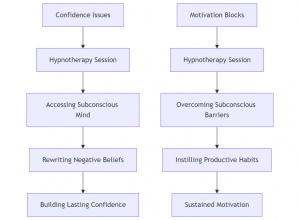





Hypnosis for Confidence and Motivation
Confidence is not something you either have or do not have.
You may feel confident in one part of your life and uncertain in another. You might be comfortable talking with friends but become anxious before a presentation. You may know exactly what you want to accomplish but still procrastinate when it is time to take action.
Hypnosis can provide a focused way to work with some of the thoughts, expectations, habits, and emotional responses that may be interfering with your confidence or motivation.
At Seacoast Hypnosis, Christine Larkin personalizes hypnosis sessions around the situations where you would most like to feel calmer, more capable, and more ready to move forward.
How Hypnosis May Support Confidence and Motivation
Hypnosis involves focused attention and an increased responsiveness to suggestion.
During a session, Christine can use guided imagery, mental rehearsal, and positive suggestions to help you focus on the responses you want to strengthen.
That might include:
- Speaking more confidently
- Preparing for an important conversation
- Feeling calmer before a presentation
- Reducing negative self-talk
- Following through on personal goals
- Working with procrastination
- Strengthening motivation
- Approaching challenges with greater confidence
Hypnosis does not install confidence into your mind or turn you into a different person.
Instead, it can help you practice and reinforce thoughts and responses that are more consistent with how you want to feel and behave.
Why Confidence Can Be Difficult to Change
Confidence is influenced by more than positive thinking.
Your previous experiences, expectations, preparation, skills, self-talk, fear of failure, and comfort with a particular situation can all affect how confident you feel.
You may logically know that you are capable and still notice thoughts such as:
“What if I fail?”
“What if I embarrass myself?”
“What if I am not good enough?”
“What if everyone notices that I am nervous?”
When these responses become familiar, they can influence what you do next.
You may avoid the situation.
You may procrastinate.
You may overprepare because you are afraid of making a mistake.
Or you may decide not to pursue something you genuinely want.
Hypnosis can give you an opportunity to work with these patterns in a focused and intentional way.
Working With Limiting Beliefs and Negative Self-Talk
Many people develop beliefs about themselves through experience.
You might repeatedly tell yourself:
“I always mess things up.”
“I am terrible at public speaking.”
“I am not confident.”
“I never follow through.”
Over time, statements like these can begin to feel less like thoughts and more like facts.
During hypnosis, Christine can help you examine the responses you want to change and reinforce more constructive alternatives.
For example:
Instead of:
“I always fail under pressure.”
you might practice:
“I can slow down, focus, and handle this one step at a time.”
Instead of:
“I am terrible at speaking in front of people.”
you might reinforce:
“I can prepare, breathe, focus on my message, and become more comfortable with practice.”
The goal is not to replace every negative thought with an unrealistic positive statement.
It is to develop thoughts and expectations that are more balanced, useful, and supportive.
Hypnosis for Fear of Failure and Judgment
Fear can have a major influence on confidence.
You may worry about being criticized, rejected, embarrassed, or making the wrong decision.
Those concerns can sometimes lead to avoidance.
The less often you face the situation, the fewer opportunities you have to discover that you can handle it.
Hypnosis may help by giving you a structured way to imagine approaching a challenging situation with greater calm and control.
For example, if public speaking makes you anxious, you might mentally rehearse:
- Walking into the room calmly
- Breathing steadily
- Looking at your audience
- Remembering your main points
- Recovering smoothly if you lose your place
- Finishing the presentation feeling satisfied that you followed through
Mental rehearsal cannot guarantee that you will never feel nervous.
It can, however, help you practice the response you want before you encounter the situation in real life.
Schedule Your Free Phone Consultation
Can Hypnosis Help With Public Speaking and Performance Anxiety?
It may help some people.
Research on hypnosis has found encouraging results for anxiety more broadly, particularly when hypnosis is combined with other psychological approaches. A 2019 meta-analysis of controlled studies found that hypnosis reduced anxiety symptoms compared with control conditions, although the studies included different types of anxiety and interventions.
For public speaking or performance-related concerns, hypnosis may be used to support:
- Relaxation
- Mental rehearsal
- Focus
- More constructive self-talk
- Reduced anticipatory worry
- Greater confidence in your preparation
If anxiety is severe or significantly interfering with everyday life, hypnosis should not replace appropriate evaluation or treatment from a qualified mental health professional.
Confidence Is More Than a Mindset
Confidence is not simply the result of thinking positively.
It is also influenced by preparation, experience, competence, and repeated practice.
If you have never given a presentation before, hypnosis cannot instantly give you years of speaking experience.
But it may help you approach practice differently.
You can use hypnosis to mentally rehearse success, focus on the skills you already possess, reduce distracting self-criticism, and prepare yourself
That combination is more realistic than expecting confidence to appear without practice.
Are Affirmations Enough to Build Confidence?
Affirmations can be useful for some people, but repeating a positive statement does not automatically change how you feel or behave.
If you tell yourself:
“I am completely confident”
while another part of you strongly believes:
“No, I am not,”
the statement may feel disconnected from your experience.
Hypnosis can offer a more focused setting for working with helpful suggestions, imagery, and mental rehearsal.
That does not mean affirmations are useless or that hypnosis is inherently superior.
The important question is whether a technique helps you develop more useful thoughts and behaviors and then apply them in everyday situations.
How Hypnosis May Support Motivation
Motivation is not constant.
You can feel highly motivated on Monday and struggle to take action by Thursday.
That is normal.
Motivation is affected by many things, including energy, stress, competing priorities, habits, expectations, and how meaningful a goal feels to you.
Hypnosis may support motivation by helping you reconnect with:
- Why your goal matters
- What you want to accomplish
- How you want to feel when you follow through
- The behaviors that move you closer to your goal
- The obstacles that tend to interrupt your progress
Instead of relying only on feeling motivated, the goal is to strengthen patterns that make action easier to repeat.
Working With Procrastination
Procrastination is not always laziness.
Sometimes you delay taking action because a task feels overwhelming, uncomfortable, boring, uncertain, or connected to fear of failure.
Hypnosis can be used to help you mentally rehearse beginning the task rather than focusing only on completing it.
For example, instead of imagining an entire intimidating project, you might reinforce:
“I can begin with the first step.”
That can be particularly useful when the biggest barrier is getting started.
Aligning Your Goals With What Matters to You
Motivation often becomes stronger when a goal connects with something personally meaningful.
Maybe you want greater confidence because you are preparing for a promotion.
Perhaps you want to stop procrastinating because you are building a business.
Maybe you want to speak up more because you are tired of holding yourself back.
During your consultation, Christine can explore why the change matters to you.
That gives your hypnosis session a more personal direction than simply repeating generic motivational suggestions.
Building More Supportive Habits
Confidence and motivation are often strengthened through repeated behavior.
One successful conversation can make the next one feel easier.
One workout can make returning tomorrow more likely.
One completed task can challenge the belief that you “never follow through.”
Hypnosis can support this process by helping you mentally rehearse behaviors such as:
- Beginning instead of postponing
- Staying focused on one task
- Preparing before an important event
- Speaking up when you have something to contribute
- Responding more calmly to mistakes
- Returning to your goal after a setback
The objective is not effortless motivation.
It is greater consistency.
What to Expect From a Hypnosis Session
Christine begins by learning about the particular situations where you want to feel more confident or motivated.
Your session might focus on:
- Public speaking
- Work performance
- Sales
- Interviews
- Academic performance
- Sports
- Social situations
- Procrastination
- Personal goals
- Self-talk
- Fear of failure
During hypnosis, Christine guides you into a comfortable state of focused attention.
You remain aware and in control throughout the experience.
She may then use suggestions, imagery, and mental rehearsal tailored to the responses you would like to strengthen.
People vary in how they experience and respond to hypnosis, and results vary from person to person.
Live Virtual Hypnosis for Confidence and Motivation
Seacoast Hypnosis offers live virtual hypnosis sessions with Christine Larkin.
You can work with Christine in real time from the privacy and comfort of home.
A live virtual session can be particularly convenient when you are preparing for something specific, such as an interview, presentation, performance, or important conversation.
Your session can be personalized around the exact situation you would like to approach differently.
Learn More About Online Hypnosis
Frequently Asked Questions About Hypnosis for Confidence and Motivation
How does hypnosis help with confidence?
Hypnosis may help you focus on thoughts, expectations, imagery, and responses connected to confidence. Sessions can include mental rehearsal, constructive suggestions, and practice responding more calmly to situations that currently trigger self-doubt.
Will I be aware and in control?
Yes. Hypnosis does not require you to surrender control. You remain aware of the experience and can choose whether to respond to suggestions.
Can hypnosis help with public speaking?
Hypnosis may support relaxation, mental rehearsal, focus, and confidence before public speaking. It cannot replace preparation or guarantee that you will never feel nervous.
Can hypnosis help with procrastination?
It may help you work with some of the thoughts and habits connected to procrastination, particularly when fear, overwhelm, or negative expectations are contributing to avoidance.
Is hypnosis better than affirmations?
They are different approaches. Affirmations involve consciously repeating statements, while hypnosis uses focused attention, suggestion, and often imagery or mental rehearsal. Neither approach guarantees a particular result.
How many sessions will I need?
That depends on your goals and individual needs. Christine can discuss the most appropriate approach after learning more about the change you would like to make.
Ready to Feel More Confident About Your Next Step?
You do not need to become a completely different person to feel more confident.
Sometimes the work is about changing the way you respond to situations that currently bring up hesitation, fear, self-doubt, or avoidance.
Christine Larkin at Seacoast Hypnosis can help you explore those patterns and strengthen responses that better support the person you want to be.